
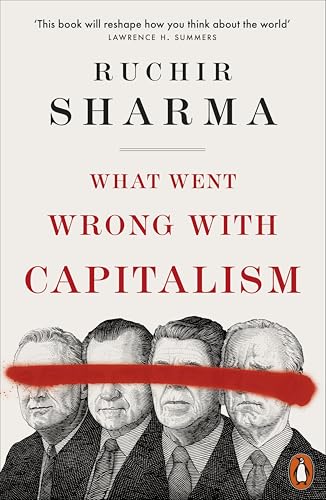
What went wrong with capitalism
Material type: TextPublication details: New Delhi : Penguin, ©2024Description: xii, 368 p. ; 20 cmISBN:
 - 9781802061031
- 330.12 SHA-W
| Item type | Current library | Collection | Call number | Status | Date due | Barcode | Item holds |
|---|---|---|---|---|---|---|---|
 Books
Books
|
IIITD General Stacks | Economics | 330.12 SHA-W (Browse shelf(Opens below)) | Checked out | 01/04/2026 | 013697 |
Browsing IIITD shelves, Shelving location: General Stacks, Collection: Economics Close shelf browser (Hides shelf browser)

|

|

|

|

|

|

|
||
| 330.09 YUE-G The great economists : | 330.10 PIK-E Equality : what it means and why it matters | 330.1 TSI-M The mushroom at the end of the world : on the possibility of life in capitalist ruins | 330.12 SHA-W What went wrong with capitalism | 330.122 CRY-I Introducing capitalism : a graphic guide | 330.122 MAZ-M Mission economy : a moonshot guide to changing capitalism | 330.122 ROI-P Pocket piketty : |
Includes bibliographical references and index.
Part 1. The rise and rise again of big government
Part 2. The perils of constant relief
Part 3. The path to balance
Capitalism didn't fail, it was ruined... What went wrong with capitalism? Ruchir Sharma's account is not like any you will have heard before. He says progressives are right, in part, when they mock modern capitalism as "socialism for the rich." For a century, governments have expanded in just about every measurable dimension, from spending to regulation and the scale of financial rescues when the economy wobbles. The result is expensive state guarantees for everyone--bailouts for the rich, entitlements for the middle class, welfare for the poor. Taking you back to the 19th century, Sharma shows how completely the reflexes of government have changed: from hands-off to hands-on, from doing too little to help anyone in hard times to today trying to prevent anyone suffering any economic pain, ever. Trading sins of omission and indifference for excesses of spending and meddling, governments from the United States to Europe and Japan have pumped so much money into their economies that financial markets can no longer invest all that capital efficiently. Inadvertently, they have fueled the rise of monopolies, "zombie" firms, and billionaires. They have made capitalism less fair and less efficient, which is slowing economic growth and fueling popular anger. The first step to a cure is a correct diagnose of the problem. Capitalism has been badly distorted by constant government intervention and the relentless spread of a bailout culture. Building an even bigger state will only double down on what ruined capitalism in the first place.
There are no comments on this title.