
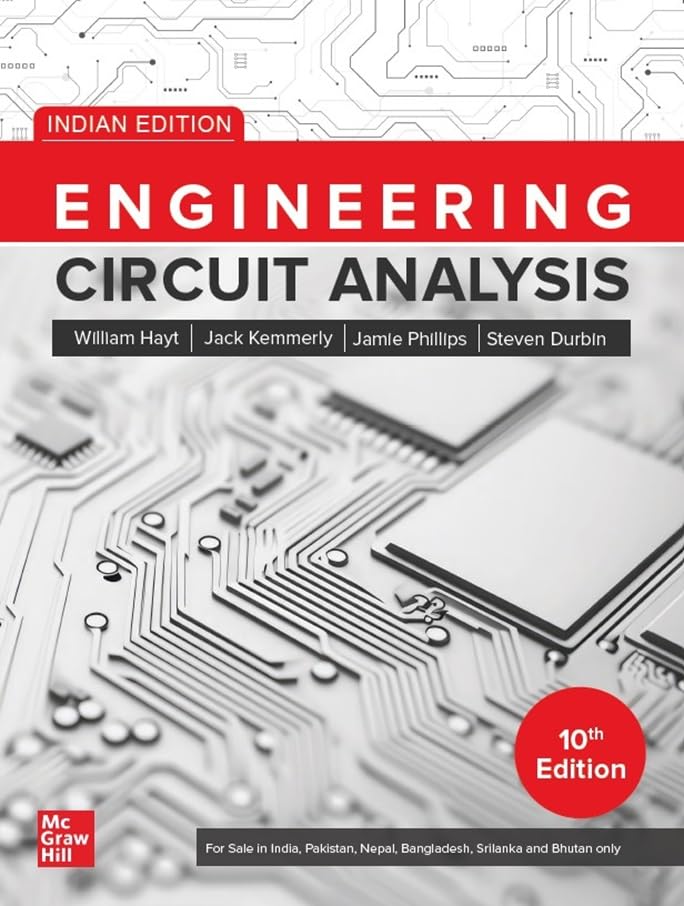
Engineering circuit analysis
Material type: TextPublication details: New York : McGraw Hill, ©2024Edition: 10th edDescription: xvi, 864 p. ; 27 cmISBN:
 - 9789364441094
- 621.319 HAY-E
- TK454 .H4 2024
| Item type | Current library | Collection | Call number | Status | Date due | Barcode | Item holds |
|---|---|---|---|---|---|---|---|
 Reference
|
IIITD Reference | Electronics and Communication Engineering | REF 621.319 HAY-E (Browse shelf(Opens below)) | Not for loan | 013672 | ||
 Books
Books
|
IIITD General Stacks | Electronics and Communication Engineering | 621.319 HAY-E (Browse shelf(Opens below)) | Checked out | 29/01/2026 | 013671 |
Browsing IIITD shelves, Shelving location: Reference, Collection: Electronics and Communication Engineering Close shelf browser (Hides shelf browser)

|

|

|

|

|

|

|
||
| REF 621.319 HAY-E Engineering circuit analysis | REF 621.319 HAY-E Engineering circuit analysis | REF 621.319 HAY-E Engineering circuit analysis | REF 621.319 HAY-E Engineering circuit analysis | REF 621.319 KUN-P Power system stability and control | REF 621.319 MIL-P Power system operation | REF 621.319 PAB-E Electric power distribution |
Includes index.
Chapter 1. Introduction
Chapter 2. Basic Components and Electric Circuits
Chapter 3. Voltage and Current Laws
Chapter 4. Basic Nodal and Mesh Analysis
Chapter 5. Handy Circuit Analysis Techniques
Chapter 6. The Operational Amplifier
Chapter 7. Capacitors and Inductors
Chapter 8. Basic RC and RL Circuits
Chapter 9. The RLC Circuit
Chapter 10. Sinusoidal Steady-State Analysis
Chapter 11. AC Circuit Power Analysis
Chapter 12. Polyphase Circuits
Chapter 13. Magnetically Coupled Circuits
Chapter 14. Circuit Analysis in the s-Domain
Chapter 15. Frequency Response
Chapter 16. Two-Port Networks
Chapter 17. Fourier Circuit Analysis
Chapter 18. State-Variable Analysis (Online)
"Although in many engineering programs the introductory circuits course is preceded or accompanied by an introductory physics course in which electricity and magnetism are introduced (typically from a fields perspective), this is not required to use this book. After finishing the course, many students find themselves truly amazed that such a broad set of analytical tools have been derived from only three simple scientific laws-Ohm's law and Kirchhoff's voltage and current laws. The first six chapters assume only a familiarity with algebra and simultaneous equations; subsequent chapters assume a first course in calculus (derivatives and integrals) is being taken in tandem. Beyond that, authors have tried to incorporate sufficient details to allow the book to be read on its own"--
There are no comments on this title.